 ContractorKeith
 on september 8, i cut ContractorProject’s schedule screen from 27 editors to two in the same 26-row test job. the page went from 6,644 pixels tall to 1,225.
the schedule was already there. i had buried it.
that is the kind of work happening inside OpenContractorOS, my suite of local business tools for contractors. the first article ought to show the actual state of the apps, because four names on a website can make a development project look further along than it is.
start with the next call
ContractorCRM has a public v0.1.0 release: a signed and notarized Mac package, and a Windows installer that is unsigned for this release.
the newer source work starts the app on Today. due tasks and neglected leads appear together, with a quick way to mark a follow-up complete or open its record. a short lead form can create a contact, an opportunity, and an optional task in one transaction.
so a lead does not need to begin with a tour of the database.
that same work added personal-agent setup and bounded work-queue and record-brief tools. read-only access is the default. the September change is merged, but these additions need a new packaged release before they reach the download above.
put the job where i can see it
ContractorProject is private development. the working app stores the work breakdown and dependencies locally, calculates the schedule in Rust, and puts the Gantt chart inside the job.
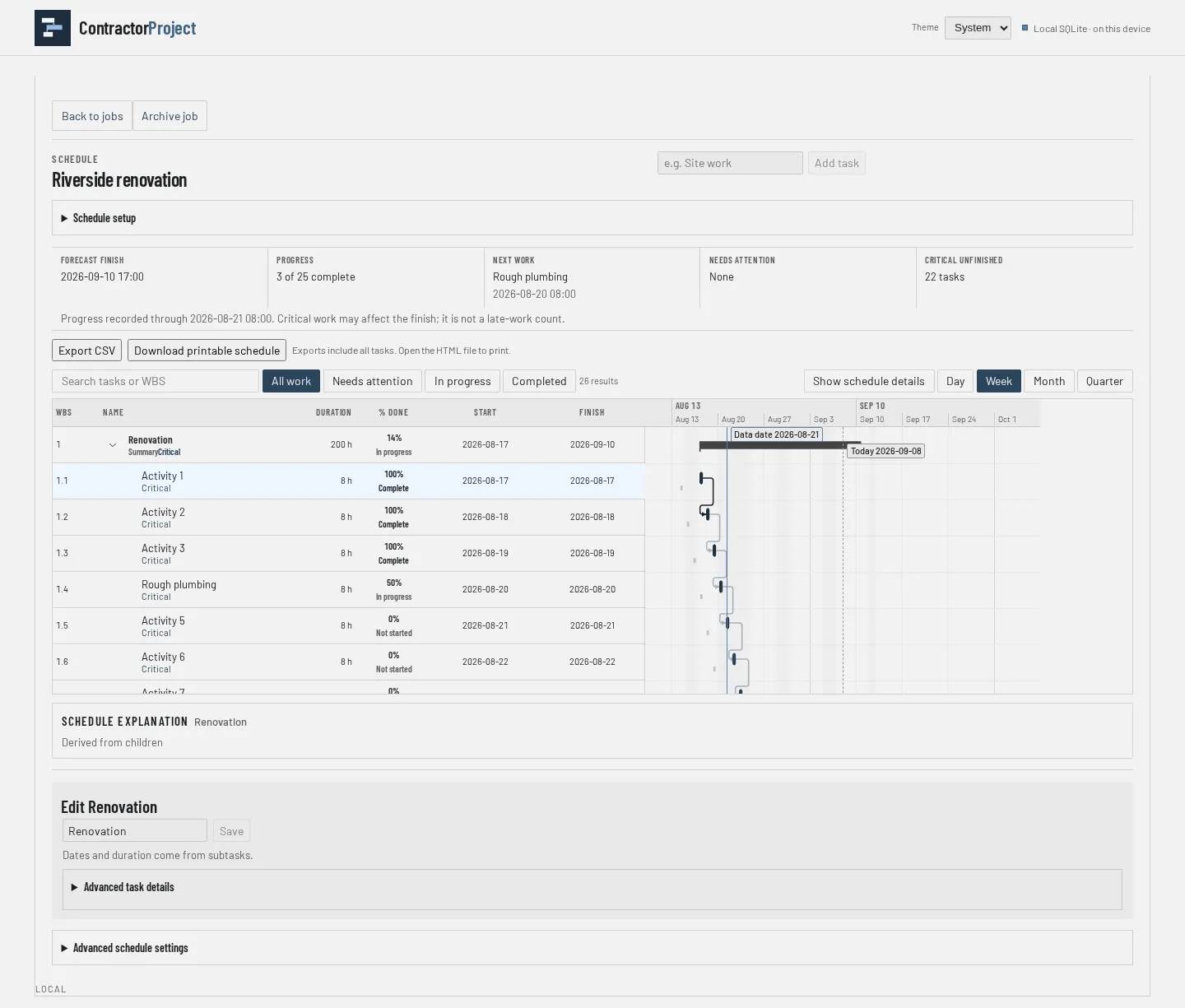
the screenshot uses a test job, not a customer’s schedule. the current screen has search, status filters, a selected-task editor, and exports for CSV or printable HTML. advanced controls stay available below the everyday work.
and the dates come from the scheduler. working calendars, dependency types, constraints, and baselines have to agree after the database is reopened. an attractive bar in the wrong week would be a fairly expensive decoration.
there is no public ContractorProject installer yet. the user docs describe the development app.
follow the money without inventing it
ContractorBooks is also private development. its working double-entry core includes invoices and payments, vendor bills, job costs, retainage, bank reconciliation, and reports.
AI proposals have a review-and-apply path. an MCP helper gives agents a separate way to use the application, with read-only access by default and audited writes when enabled. the financial operations belong to the same application layer the interface uses.
release packaging is still work in progress. there is no public Books download, and ContractorEstimate is earlier still: product planning for estimating and quoting, without a working release.
separate apps, deliberate hand-offs
i want a contractor to follow a lead into a quote, a job, and the books without maintaining four conflicting copies of the same customer, but that whole journey is not finished today.
the modules have their own data and release schedules. shared references and hand-off formats are part of the work; a suite name does not make every integration automatic.
this also explains a change since my home-services software article. that was an evaluation of existing systems. OpenContractorOS is my narrower attempt at local desktop tools, and the cost of building and maintaining them is mine to carry.
start with the CRM install guide, or follow the suite documentation. i will keep the project statuses tied to the builds people can actually get.