 ContractorKeith
 update, september 8, 2026: Ködade 2.0.2 is the current Mac release. structured chat now includes Grok Build and OpenCode. the August Windows target elapsed; Windows remains in development and Linux desktop is planned. the article below records the August 2 launch.
at 3:04pm on august 2, i published ködade 1.4.14. the first public build is a signed and notarized .dmg for Apple silicon Macs running macOS 13 or newer.
the whole repo is public, too. Apache 2.0. no source split, no required Ködade account, and no paid tier hiding half the app.
and this is not nights-and-weekends work anymore. after 37 years in the trades and my last stretch as a commercial estimator, i left estimating to do agentic engineering full time.
one month in. here we go.
why i opened it up
when i wrote about ködade in july, i was still thinking in free and pro columns. the more i built, the less sense that made.
ködade sits around tools people already trust with their code, shell, and credentials. if i expect somebody to put their working directory inside it all day, they should be able to inspect the code that touches those boundaries. they should also be able to fork it, fix something i missed, or make it work on a machine i do not own.
so i picked Apache 2.0 and opened the doors. i want the bug reports from odd shells, the pull requests from Windows people, and the arguments about how agent memory ought to work. my machines only find my problems.
that matters more than protecting a feature list.
what ships today
ködade is an ADE, an agentic development environment. the short version is that it gives the agent CLIs you already use one native workspace without pretending to be those agents.
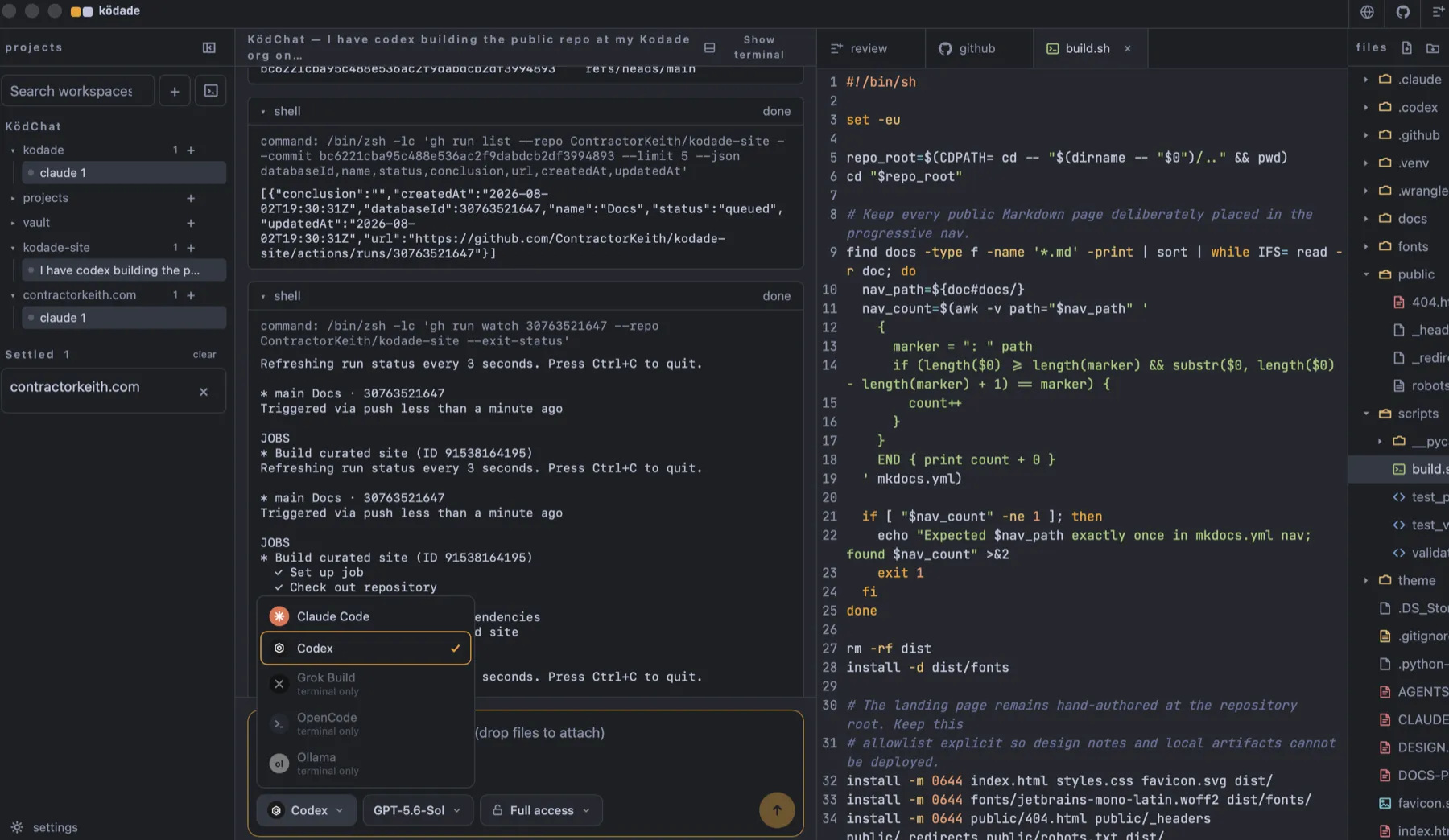
the public macOS build has:
- KödChat for Claude Code and Codex, with provider, model, and access controls in the composer.
- real terminals for Claude Code, Codex, Grok Build, OpenCode, or plain shell work. each terminal uses your login shell, PATH, configuration, and existing sign-in.
- project workspaces that can hold several chats and terminals at once. one job can run while you review another without building a yard sale of windows.
- a live file tree, CodeMirror editor, tabs, image and markdown previews, and working-tree review with unified or split file diffs.
- a GitHub surface for issues and pull requests, plus a built-in browser that keeps docs, local previews, and agent browser work beside the code.
- KödHarness and KödSkills, which show the instruction files, skills, subagents, and MCP servers each supported CLI can actually see.
- KödMem and KödMCP for local project history, saved decisions, readable working memory, and agent access to that context.
- system, light, and dark appearance, shared across the app chrome, terminal, and editor.
the terminal part is literal. sign in to Claude Code or Codex the same way you already do and use the subscription you already pay for. ködade never proxies the model call and never holds the provider credential.
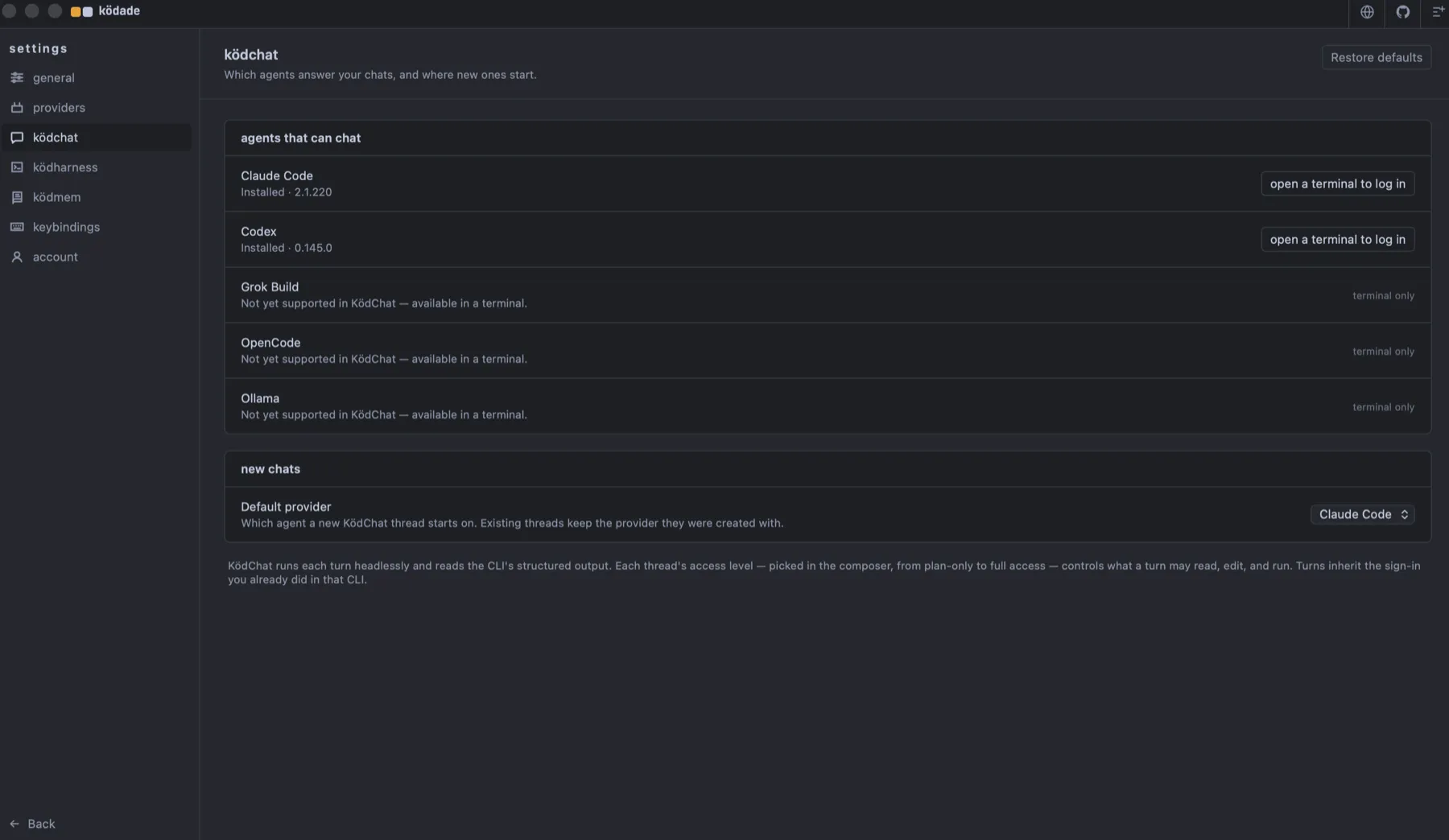
Claude Code and Codex have the structured KödChat path today. Grok Build and OpenCode still run in their real terminal interfaces. that line is visible in the app instead of buried in a footnote.
the difference i cared about
most agentic development apps want to become the agent or put another billing layer between you and the model. ködade is the workbench around the agents.
your Claude Code setup stays Claude Code. your Codex setup stays Codex. the shell prompt, hooks, MCP servers, skills, and subscription sign-in you already spent time getting right come with you because ködade launches the official CLIs on your machine.
but now the work has a place. projects are on the left. chats and terminals stay attached to them. files, diffs, GitHub, and the browser sit beside the conversation. you can run several agent sessions without losing which terminal belongs to which repo.
simple idea. a lot of wiring.
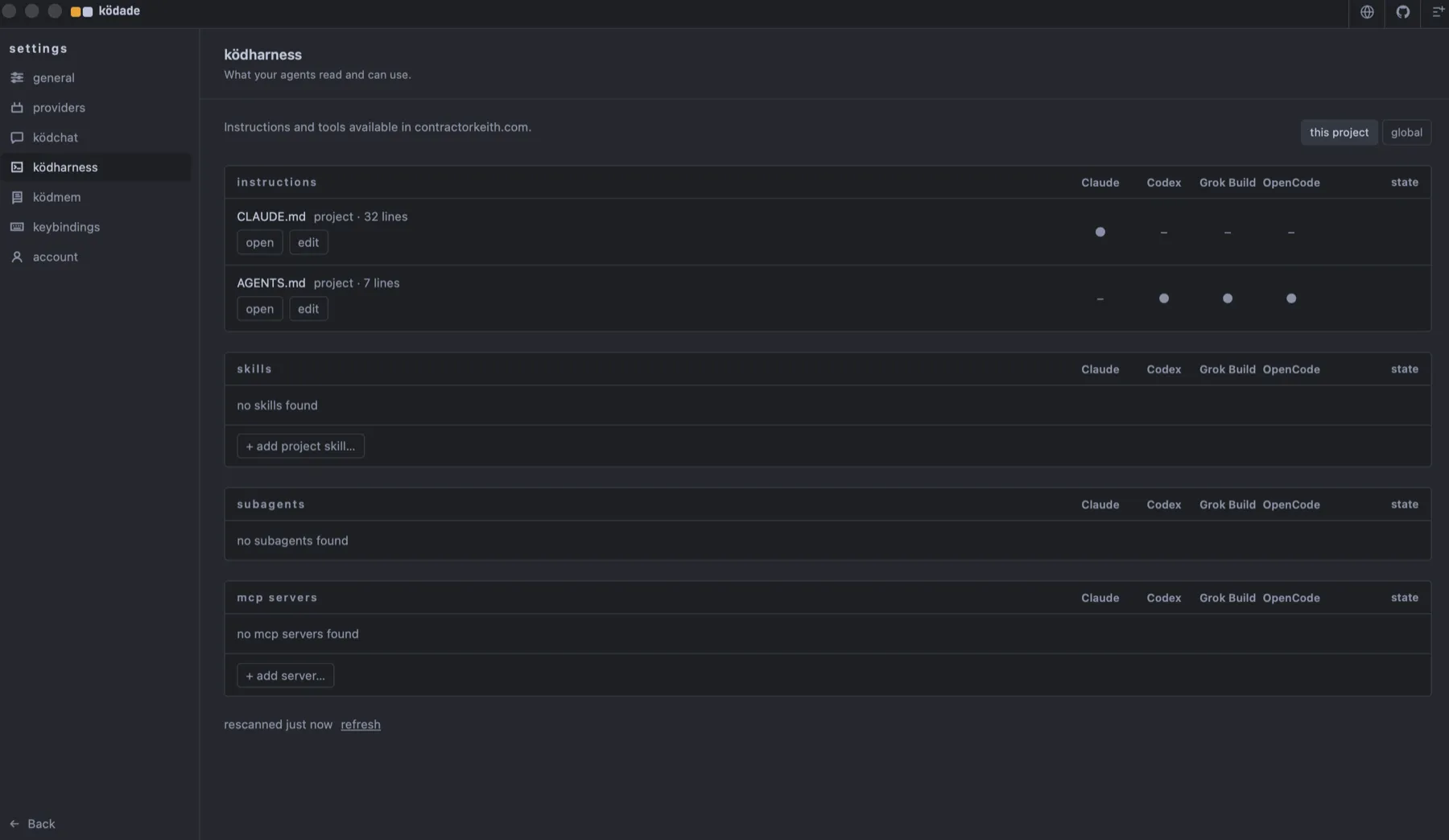
KödHarness is a good example of why the wrapper matters. one project on my machine has CLAUDE.md for Claude Code and AGENTS.md for Codex, Grok Build, and OpenCode. the matrix shows that difference before an agent runs, and edits go through a diff preview instead of a blind overwrite.
KödMem handles the other end of the session. timeline checkpoints, saved decisions, tasks, and project summaries stay local, and the working-memory option can write readable files under .kodade/memory/ with the repo.
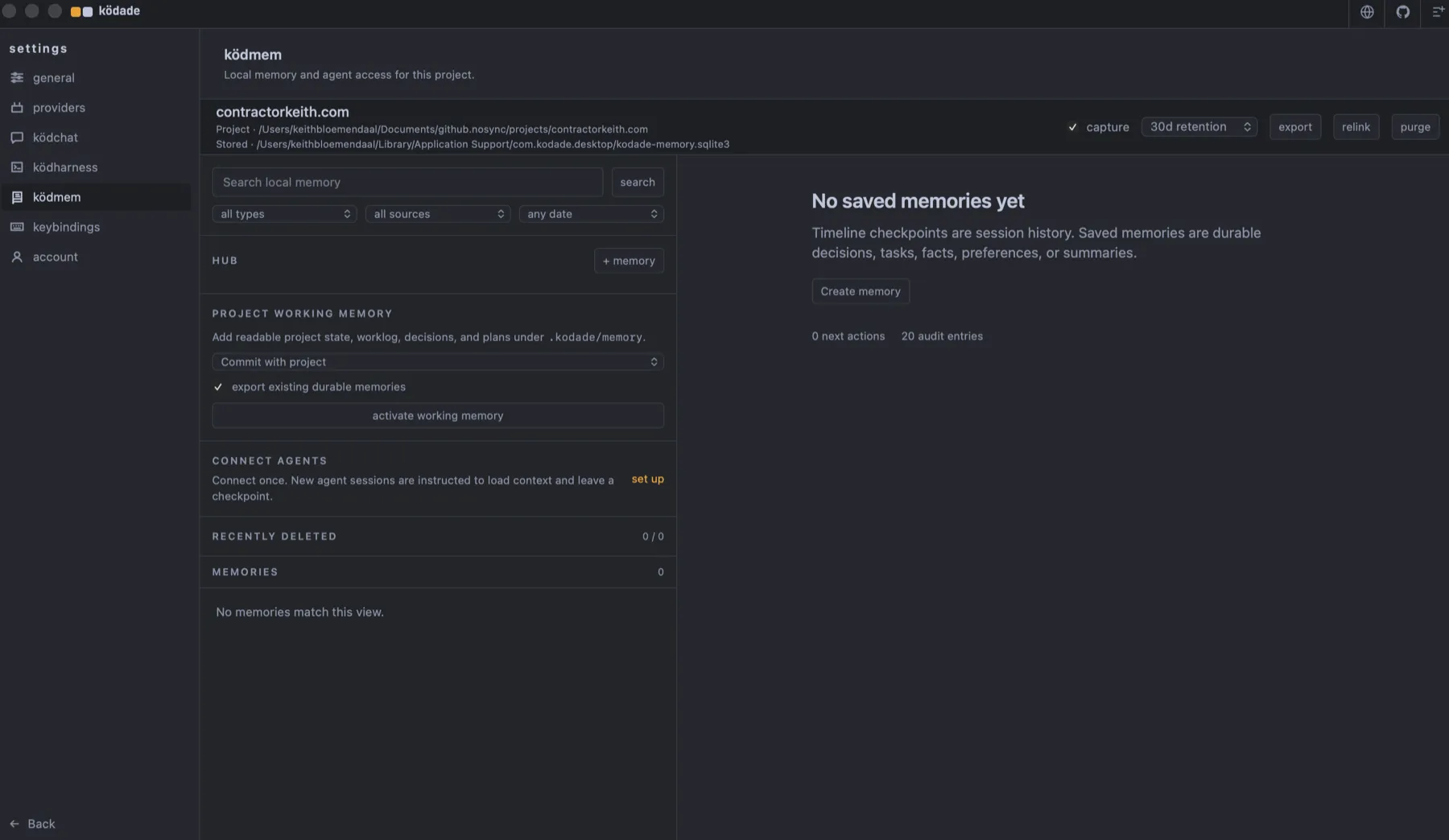
the screenshot has zero saved memories because i had just pointed the release build at this site. honest empty state. give it a few sessions.
what is still being built
the repo contains more than the public package. i kept the unfinished source visible, but the public build leaves those controls and native commands out until they are ready.
KödLocal will let you chat with models on your own hardware and eventually use them as workers beside frontier agents. GGUF and MLX are the first targets. no extra local-model app to babysit.
KödSSH will put a VPS, Mac Studio, or any machine from your own ssh configuration into the project rail. the goal is to keep the same chats, terminals, and files available when the work is running somewhere else.
KödWhisper is local voice-to-text inside the app. hold a key, talk through a long prompt, review the text, then send it. repo vocabulary and agent commands are part of the plan because software names are where generic dictation falls down first.
the working-tree diff is in 1.4.14. the deeper KödPR work adds branch and pull-request review, risk-ranked reading order, line comments, and fix prompts routed back to the agent session. parts of that work already run in my development build, but i am not calling the whole thing supported yet.
at launch, i targeted Windows for the first week of august, with Linux afterward. that target elapsed; see the September update above. more themes are in development too, beyond the system, light, and dark choices shipping now.
download it, read it, break it
the launch Mac build and its sha256 file are on the Ködade 1.4.14 release page. installation notes and the current feature boundary are at kodade.com and in the docs.
if you would rather build it yourself, the repo has the pnpm, Rust, and Tauri commands. contributions use signed-off commits, and security reports have a private path instead of a public issue.
a month ago ködade was my private way of keeping too many agents under one roof. now the roof plans are on GitHub.
come find the crooked boards.